From the source:
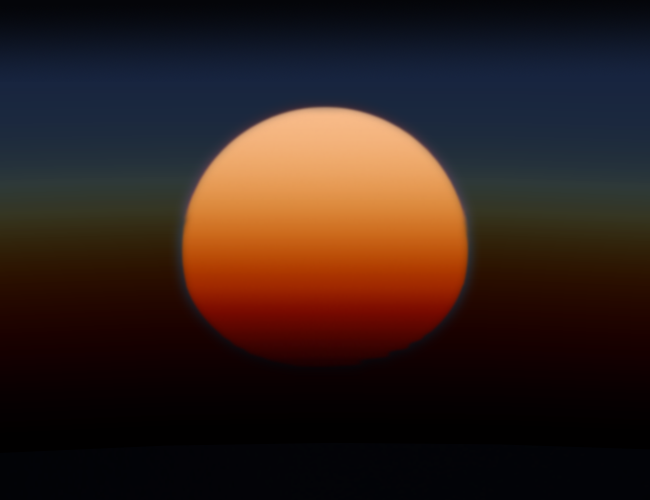
Basically, the sunset looks like a glorious sunset on Earth, on a very clear day with some dust in the air. This is because in both cases, Rayleigh scattering is the dominant mechanism. On Earth the scattering is caused by molecules and air-borne dust in the air. On ’189 the Rayleigh scattering is thought to be caused by silicate dust. One key difference with a sunset on Earth is that the “sun” appears much larger from ‘189, because the planet is very close. As a result, there is no perspective from which the star would fit in only one layer of the atmosphere, as it does in an Earthly sunset. Instead of changing colour as it moves near the horizon, the host star of ‘189 spans all colours at once, from its original orange (HD 189733 is a star much cooler than the Sun, it is orange rather than white) to very dark red in the thick layers of the lower atmosphere. In this plot the geometry is as would be observed from a space station orbiting about 10 000 km above ‘189. The star is 25 times larger in the sky than the Sun from Earth.
Credit: Prof. Frédéric Pont
